Guidelines for students in DTP
Department of Theoretical Physics (DTP) is a part of the Subject Board of Physics (SBP) at TIFR. All of SBP guidelines apply to students enrolled in DTP.
SBP webpage is the first place for any information related to our graduate school procedures. This page is intended to serve as a resource for the needs of DTP students.
Graduate School Courses
We recommend that all students should read the guidlines on the SBP webpage to understand the expectations of the TIFR graduate program. The following bullet points might be useful for graduate courses:
-
Course Work: Details of the course requirements including a schedule of courses can be found on this link
-
Course Content: Level 1-3 and Level 4
-
RCPI: All DTP students must satisfy the minimum restrictive CPI (RCPI) requirement at the end of first year. The details about RCPI can be found on DTP-RCPI-link. This also means that all courses used for RCPI calculation are compulsory for DTP students.
-
Introduction to DTP Seminar: All incoming DTP students (I-PhD and PhD) must attend the mandatory extended orientation seminar series during their first semester. The series runs every Monday from 4:00-5:30 PM in Room A304 and features faculty presentation and discussion. Students must attend at least 80% of the lectures as a mandatory requirement before they can register for department projects.
-
IPhD-100: They have to complete 15 core courses with total 72 credits. Out of these they need to do 28 credits worth of elective courses.
At least 4 of the Graduate Electives GE(1) - GE(7) must be taken from the PHY-3xx.1 level out of which at least 2 courses must be of PHY-30x.1 variety
-
IPhD-80: They have 11 core courses with total 52 credits. They need to do 28 credits worth of elective courses.
At least 4 of the Graduate Electives GE(1) - GE(7) must be taken from the PHY-3xx.1 level out of which at least 2 courses must be of PHY-30x.1 variety
-
PhD: They have 9 compulsory core courses with total 38 credits. Note that total listed core couses are 10 but only one of AQM and QM-II is compulsory. They need to do 22 credits worth of elective courses.
At least 2 of the Graduate Electives GE(1) - GE(4) must be taken at the PHY-4xx.1 level.
At most, 1 course of PHY-30x.1 variety can be taken.
AQM can be replaced by GE(2) in the first semester, provided QM-II is taken in the second semester.
It is important to take the course work seriously as they are critical part of the graduate program. We recommend attending classes regularly and not to take too many courses. It is okay to have problems in the early weeks and students are welcome to talk to the course instructor, NSAAC members or the course co-ordinator if they face difficulty. It is better to discuss problems early and we are happy to help by providing a vibrant and supportive environment.
Important Note: You must keep the DTP office and SBP representatives updated in timely manner about any significant change of your academic status. This could be for example about your decision to change the department, change of advisor, or to exit the graduate programe. Please note that it is mandatory for you to declare your leave well in advance by submitting leave application at the DTP office.
Departmental Projects and Thesis Supervisors
There are two departmental projects (DP-I and DP-II) as a part of the above course requirements. These DP's are important part of your future PhD thesis. They provide a way to take informed decision for both students and supervisor. Students are also expected to learn critical skills such as scientific writing, presentations, literature review and critical analysis of scientific papers. The students should consider talking to as many faculty members as possible before deciding their DP's. While talking to potential supervisor, ask clear question. Do not assume consent just because someone gave you some reading material. If someone does give you some reading material before committing to as supervisor, go back and talk to them. We work on a diverse set of theoretical physics problems in DTP. You can find the list of current department members on this webpage. The research area in the DTP is loosely divided into following four groups:
-
CAP: Cosmology and Astro-particle Physics
-
CMSP: Condensed Matter and Statistical Physics
-
HEP: High Energy Physics
-
STMP: String Theory and Mathematical Physics
The best way to learn about different groups is by interacting with the current members and attending their journal clubs. We recommend giving a careful consideration for these subject areas while surveying the department for DP's.
While going through your course work and DP one should keep in mind the timeline leading to thesis registration. The thesis registration has to be done before the completion of 2 years for PhD students and 3 years for IPhD students. The thesis registration comes with increased stipend for students and we encourage our students to finalize a supervisor and complete thesis registration in time.
Seminars and Colloquia
An important responsibility of our department is to provide a vibrant environment with many opportunities for intellectual interacts while providing exposure to frontier research. One of the primary medium to do this is through seminars and colloquiums within the department and wider institute. It is a valuable experience for everyone but particularly for students. We advice our students to try their best in attending as many of these seminars and colloquia as possible. We understand that for a new student, many of these seminar might be hard to follow in the beginning, but it is an important part of your scientific journey.
The list of DTP seminars and colloquia can be found on our events webpage. TIFR-wide list of seminars can be found on TIFR Indico webpage. You can add any of the seminar to your calendar using the panel on top-right of the indico event page. We have following seminars and journal club within the department.
Mental Health
You have just moved to a new environement. For some it may be first time being away from family. It is natural that aclamatising to the new place, the burden of course work, assignments, selecting your research area may feel overwhelming at first. Give it some time to adjust. Our department pays special attention to offer inclusive and supportive atmoshphere. However, in case you are feeling anxious, depressed, or uncomfortable we recommend you to address your feeling. Do consider talking to your peers, faculty members, or SBP representatives (mentioned below) of the department. Our department has constituted the NSAAC committee (mentioned below) especifically to adrress your concerns.
Professional Mental Health Support: You should also consider getting professional help by consulting our medical section for both physical and mental health issues. They provide a variety of services to the members of the institute, especially a counselling service for mental health, as listed on their website. To support mental health and emotional wellbeing, the Institute has subscribed to YourDOST - an online counselling platform. Students can access professional counselling services free of charge, directly using their TIFR email ID, without requiring prior authorization from the Institute. Beyond this there are several resources available on the web and we encourage you to educate yourself about mental health with a critical mind from the beginning of your time at TIFR.
Student Support Cell (SSC)
The Institute has established a pan-TIFR Student Support Cell (SSC) to assist students in matters related to their wellbeing. Students are encouraged to reach out to any SSC member they feel comfortable approaching for support regarding any concern or issue. SSC members are here to listen, provide guidance, and suggest appropriate courses of action. This may include referring students to relevant committees such as the Student Grievance Redressal Committee (SGRC), Anti-Ragging Committee, or Gender Harmony Committee for filing complaints or grievances. They may also recommend suitable academic interventions if needed. If you're unsure about what steps to take or simply need someone to talk to, SSC members are your first point of contact. All conversations will be treated with strict confidentiality and handled with sensitivity and without prejudice. For more details, please visit the SSC website.
Plagiarism
Oxford university defines the plagiarism as follows:
``Presenting work or ideas from another source as your own, with or without consent of the original author, by incorporating it into your work without full acknowledgement. All published and unpublished material, whether in manuscript, printed or electronic form, is covered under this definition, as is the use of material generated wholly or in part through use of artificial intelligence (save when use of AI for assessment has received prior authorisation e.g. as a reasonable adjustment for a student’s disability). Plagiarism can also include re-using your own work without citation. Under the regulations for examinations, intentional or reckless plagiarism is a disciplinary offence.''
Plagiarism is equivalent to a fraud and we expect our students avoid such actions. A more detailed discussion on the plagiarism can be found on Oxford University webpage, which we encourage all students to understand and pledge to avoid plagiarism.
First-year advice
Following is a list of quick bullet points that might be worth keeping in your mind:
-
Talk to people (peers, postdocs, faculties, and visitors): A curious mind is highly valued in our department.
-
Course Work: Sincerity and discipline is important to complete the course work requirement. Attend classes regularly and do not take too many coures in one semester.
-
Be regular about your course assignments. It is normally acceptable to discuss among peers about the assignments, but copying is forbidden.
-
Attend talks: Initially it might be hard to follow but as you get used to the language, it will prove to be a valuable habit.
-
Senior students are a valuable source of advice for coursework and research related doubts. Ask multiple people to get diverse viewpoints
-
As a part of research you will be required to develop strong reading, writing, and speaking skills. You may find the following tools helpful [grammarly, writefull]
-
Browsing through papers on arXiv is a useful habit. It may even give you ideas on what to work on for your PhD.
-
Work life balance: Find something you enjoy beyond your work and make sure you have time to take rest from work everyday.
-
Mental Health: Learn about your own mind. Pay attention to mental health.
-
Atmosphere: You play a major role in department's atmosphere. Feel free to recommend activities and help start them in the department.
-
Community: Be pro-active and take up volunteering opportunity in and outside the department
-
Outreach: TIFR provides a number of avenues for students to participate in Science Outreach. You may find more information at TIFR Outreach.
-
Trivial vs critical: Learn to distinguish between trivial and critical things for you and prioritise things accordingly.
-
Reflect: Often reflect on yourself with a big picture to plan your realistic trajectory.
-
You may find this set of advices from Steven Weinberg quite useful.
Support
-
DTP has New Students' Academic Affairs Committee (NSAAC) with the aim to provide early career mentorship to the new students.
The current members of NSAAC are Shadab Alam, Onkar Parikkar, Abhijit Gadde, Sandeepan Gupta, Tridib Sadhu, and Rishi Sharma.
-
For any general question, student can also approach SBP representative (currently: Shadab Alam and Onkar Parikkar).
-
Members of DTP office are also available to help with any administrative task.
-
For any technology related help you can approach Mr. Ajay Salve and Mr. Kapil Ghadiali (office: A318)
Gallery
DTP student's group photo
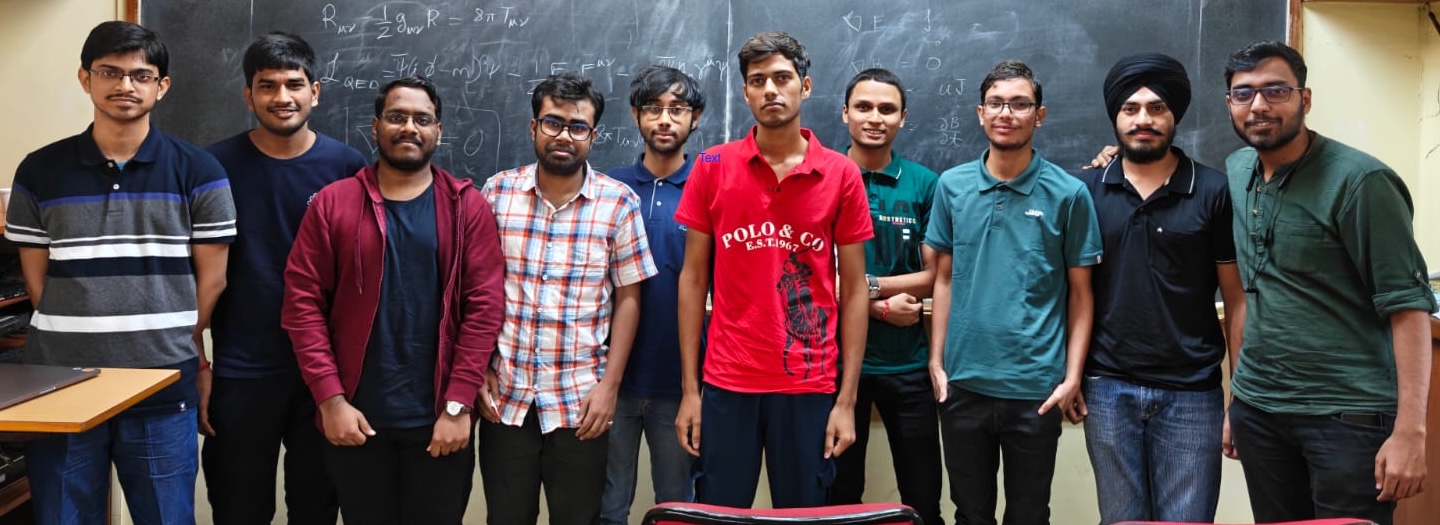
Class of 2025 from left: Swarajit Dhar, Mangol Das, Sagar J C, Gourab Dutta, Mainak Roy, Shubham Sharma, Snehasis Das, Mayank Sharma, Abhijeet Singh, Deepak Kumar Sharma
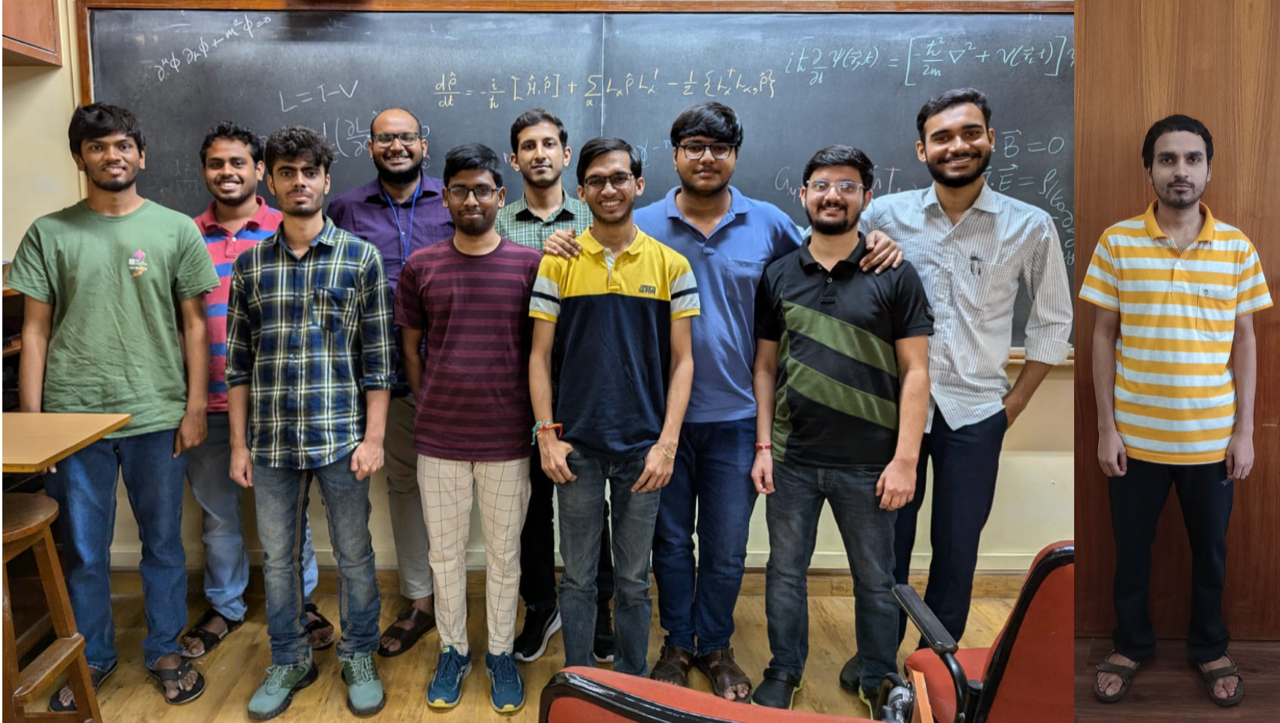
Class of 2024 from left: Susmit Walve, Manav Dharewa, Vinayak Saxena, Vinayak Mishra, Subhadip Ghara, Rohan Chakraborty, Aaghaz Mahajan, Aitijhya Saha, Shubham Verman, Aditya Nath Dwivedi, Souvik Mondal
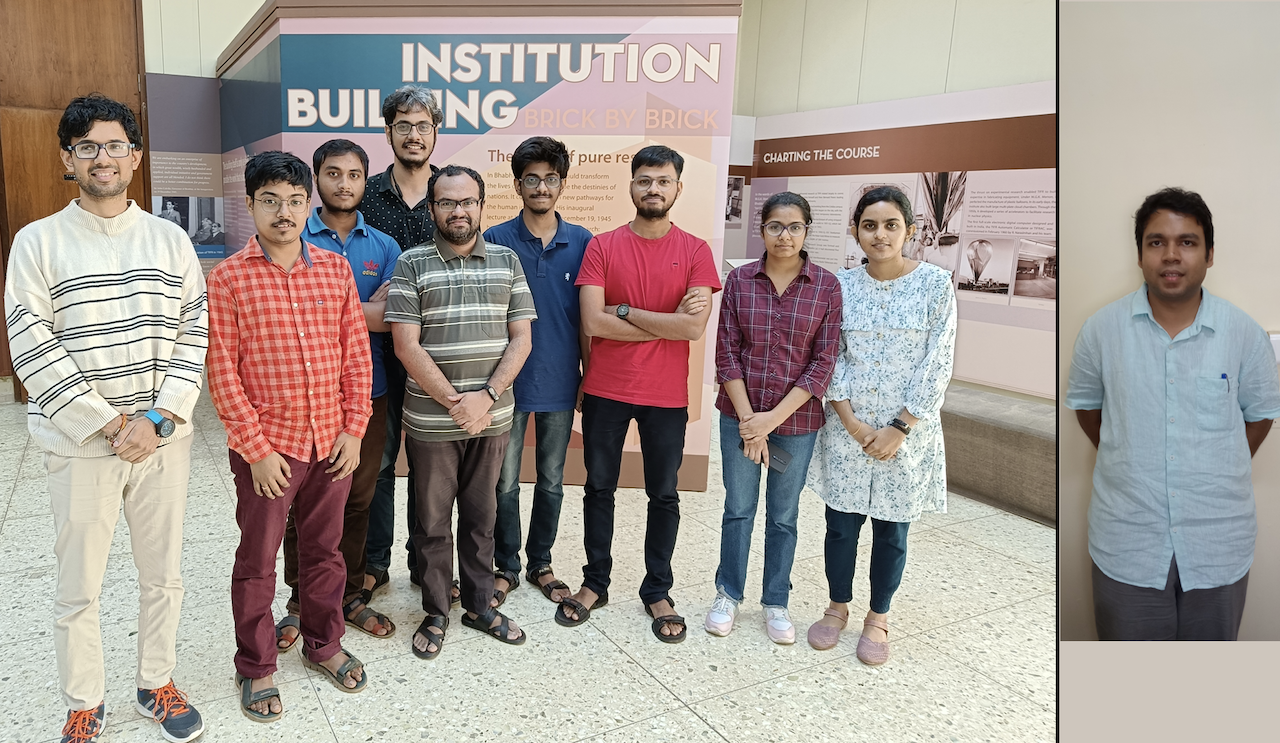
Class of 2023 from left: Apoorve Mishra, Uddipan Pal, Suman De, Jahaan Thakkar, Pabitra Ray, Satyam Das, Tushar Satapathy, Sonal, Hridya R, Swanith Upadhye