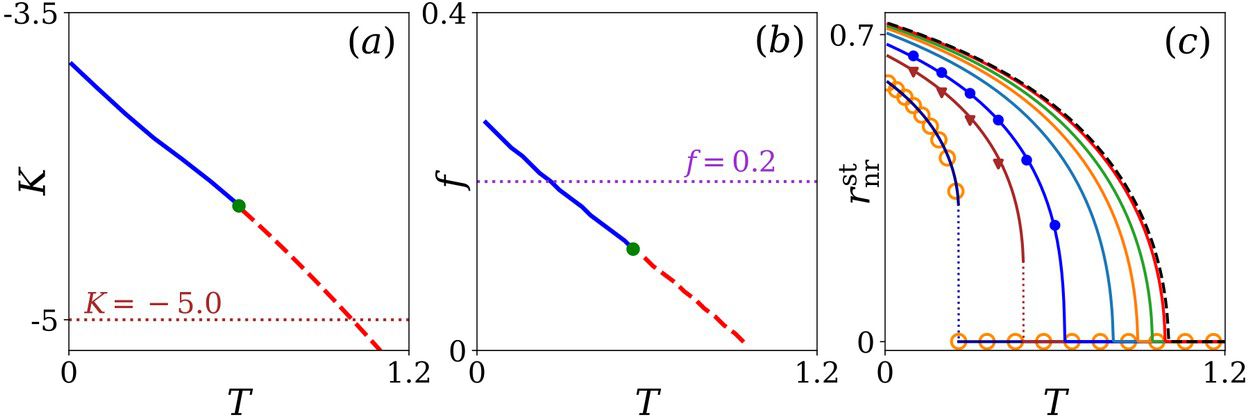
Subsystem Resetting: TIFR researchers discover a new route to control phase transitions in complex systems
Researchers in DTP have discovered that instead of manipulating every component or modifying interactions in a many-body system, occasionally resetting just a small fraction can reshape how the entire system behaves macroscopically, including how it transitions from one phase to another. This counterintuitive approach, called subsystem resetting, offers a powerful, universal control strategy to tune collective behavior in complex systems ranging from magnets to neural networks.
In everyday life, a gentle nudge at the right moment can prevent a system from spiraling - resetting a frozen computer, rebooting a router, or tapping a malfunctioning machine. The researchers show that a similar idea works in physics, but with a deeper consequence. "The most surprising insight is that you can reshape the entire phase behavior of a many-body system without ever touching the interactions or the majority of its degrees of freedom," says Prof. Shamik Gupta. "In statistical physics, the orthodoxy is that to change a phase transition, you must change couplings, external fields, geometry, or temperature. Yet this study shows that you can move, split, eliminate, or recreate phase transitions exactly as you like, simply by occasionally resetting a small fraction of the system to a chosen state."
At the heart of the mechanism is non-equilibrium dynamics. "Resetting breaks detailed balance, thereby inducing a nonequilibrium structure. It biases macroscopic order indirectly through the reset subsystem, exploits long-range interactions to propagate that bias, and turns memory effects into a stabilizing force," Gupta adds. "Control emerges from an intricate interplay of noise, memory, and incomplete intervention."
This work by Anish Acharya, Rupak Majumder, and Prof. Shamik Gupta has been published in Physical Review Letters.

DTP scientists launch project IMPETUS.
Along with colleagues from high energy physics and nuclear physics, members of DTP initiate the project title "Indian Mission in Positronium Experimental Thrust for Ultra-precision Searches" or IMPETUS, with the vision to build an End2End Indian experiment.

TIFR Hosted the 42nd International Symposium on Lattice Field Theory in Mumbai
TIFR hosted the 42nd International Symposium on Lattice Field Theory (Lattice 2025) during 2-8,2025. It was one of the world's most influential gatherings in high-energy theoretical physics. Prof. Gunnar Bali, Prof. Saumen Datta, Prof. Rajiv Gavai, and Prof. Nilmani Mathur from DTP, TIFR, Mumbai, and Dr. M. Padmanath from IMSc, Chennai were part of the Local Organizing Committee.
Do we even need an axion
Results from DTP scientists suggest that there might not be a strong CP problem in the Standard Model afterall.
DTP members propose new observables in the hunt for dark matter
Composite dark matter with electromagnetic transitions can absorb CMB photons and leave characteristic spectral distortions in the cosmic microwave background spectrum
Prof. Matthias Neubert (MITP) delivered the 6th D P Roy Memorial Lecture
"Prof. Matthias Neubert deliverd a lecture titled ‘Landscapes of Fundamental Physics’. Prof. Neubert is a Theoretical Particle Physicist at Johannes Gutenberg University (JGU), Mainz, and is the Founding Director of the Mainz Institute for Theoretical Physics (MITP).Landscapes of Fundamental Physics." His research spans QCD, collider and flavor physics, CP violation, effective field theories, and physics beyond the Standard Model. He currently serves as Spokesperson for the Cluster of Excellence, PRISMA+ (Precision Physics, Fundamental Interactions and Structure Matter) at JGU.
Prof. Michelangelo Mangano (CERN) delivered the 5th D P Roy Memorial Lecture
"Prof. Michelangelo Mangano deliverd a lecture titled ‘Visible and Invisible in Fundamental Physics & Art.’. Prof. Mangano is a senior theoretical physicist at CERN. His research spans collider physics, quantum field theory, and the role of “invisible” phenomena in our understanding of the universe. The lecture paid tribute to Prof. D.P. Roy and explored how physics and surrealist art converge in their shared fascination with the unseen.
A Novel Family of Beautiful–Charming Tetraquarks
DTP scientists publish new lattice results in non-perturbative QCD.
Subsystem Resetting: TIFR researchers discover a new route to control phase transitions in complex systems
Researchers in DTP have discovered that instead of manipulating every component or modifying interactions in a many-body system, occasionally resetting just a small fraction can reshape how the entire system behaves macroscopically, including how it transitions from one phase to another. This counterintuitive approach, called subsystem resetting, offers a powerful, universal control strategy to tune collective behavior in complex systems ranging from magnets to neural networks.
In everyday life, a gentle nudge at the right moment can prevent a system from spiraling - resetting a frozen computer, rebooting a router, or tapping a malfunctioning machine. The researchers show that a similar idea works in physics, but with a deeper consequence. "The most surprising insight is that you can reshape the entire phase behavior of a many-body system without ever touching the interactions or the majority of its degrees of freedom," says Prof. Shamik Gupta. "In statistical physics, the orthodoxy is that to change a phase transition, you must change couplings, external fields, geometry, or temperature. Yet this study shows that you can move, split, eliminate, or recreate phase transitions exactly as you like, simply by occasionally resetting a small fraction of the system to a chosen state."
At the heart of the mechanism is non-equilibrium dynamics. "Resetting breaks detailed balance, thereby inducing a nonequilibrium structure. It biases macroscopic order indirectly through the reset subsystem, exploits long-range interactions to propagate that bias, and turns memory effects into a stabilizing force," Gupta adds. "Control emerges from an intricate interplay of noise, memory, and incomplete intervention."
This work by Anish Acharya, Rupak Majumder, and Prof. Shamik Gupta has been published in Physical Review Letters.
DTP scientists launch project IMPETUS.
Along with colleagues from high energy physics and nuclear physics, members of DTP initiate the project title "Indian Mission in Positronium Experimental Thrust for Ultra-precision Searches" or IMPETUS, with the vision to build an End2End Indian experiment.
The IMPETUS initiative is a phased national program aimed at establishing an end-to-end Indian precision experiment based on the positronium system. The initiative aligns with listed goals both in the DAE Vision-2047 the Mega Science Vision (MSV) documents in nuclear and particle physics. It seeks to build a coordinated and interdisciplinary national effort that integrates expertise across high-energy physics, nuclear physics, optics, materials science, detector development, and data science to perform world-leading precision studies of positronium decays and rare processes.
The program will enable best-in-class searches for physics beyond the Standard Model (BSM), including milli-charged particles, axion-like particles, Z′ resonances, and electromagnetic moments of the dark matter, while also advancing fundamental tests of discrete symmetries and quantum correlations. In parallel, this initiative will leverage the same detector platform for interdisciplinary applications such as quantum entanglement studies, precision nuclear form-factor measurements, quantum sensing, and the development of advanced medical imaging technologies.
TIFR Hosted the 42nd International Symposium on Lattice Field Theory in Mumbai
TIFR hosted the 42nd International Symposium on Lattice Field Theory (Lattice 2025) during 2-8,2025. It was one of the world's most influential gatherings in high-energy theoretical physics. Prof. Gunnar Bali, Prof. Saumen Datta, Prof. Rajiv Gavai, and Prof. Nilmani Mathur from DTP, TIFR, Mumbai, and Dr. M. Padmanath from IMSc, Chennai were part of the Local Organizing Committee.
Do we even need an axion
Results from DTP scientists suggest that there might not be a strong CP problem in the Standard Model afterall.
DTP members finds a new way to derive the effective infrared of a strongly coupled QCD.
DTP members propose new observables in the hunt for dark matter
Composite dark matter with electromagnetic transitions can absorb CMB photons and leave characteristic spectral distortions in the cosmic microwave background spectrum
New class of CMB spectral distortions were predicted that arise from absorption of the CMB photons by multi-state dark matter. Such signatures are a natural prediction of a class of composite dark matter models characterized by electrically neutral states but with nonzero higher order electromagnetic moments. The nature of spectral distortions depends sensitively on the dark matter transition frequency and the strength of couplings of dark matter with visible sector particles as well as its self-interactions, thus opening a new window to probe the nature of dark matter. The non-thermal distortions thus created were computed and shown to have unique spectral shapes making them distinguishable from the standard thermal distortions and potentially detectable in the next-generation experiments such as Primordial Inflation Explorer (PIXIE). The spectral distortion limits from the cosmic background explorer/far-infrared absolute spectrophotometer (COBE/FIRAS) were computed and were found to already give a constraint on the electromagnetic coupling of dark matter, which is 3 orders of magnitude stronger compared to the current direct detection limits for the mass dark matter of the order of few times the electron mass and transition energy in the optical range.
Building an Ecosystem to Transform India's Science Education
While India's prestigious undergraduate institutions like the IITs and IISERs serve as global symbols of scientific excellence, they represent just the tip of an educational iceberg. Beneath the surface lies a very different reality: among thousands of local colleges offering undergraduate science courses, many struggle with outdated curricula, overworked faculty, and a fundamental disconnect from industry needs. The numbers paint a stark picture. Despite India's expanding science and technology landscape, career opportunities remain limited.
Recognizing that this crisis couldn't be solved from within academic bubbles, Shadab Alam and Darshan Joshi, faculty at DTP and TIFR Hyderabad, respectively, embarked on an ambitious experiment in June 2025. The Science Education Ecosystem (SEE) workshop brought together 65 participants from across Maharashtra's educational spectrum - university teachers, government officials, industry experts, and students - for three intensive days of problem-solving.
Prof. Matthias Neubert (MITP) delivered the 6th D P Roy Memorial Lecture
"Prof. Matthias Neubert deliverd a lecture titled ‘Landscapes of Fundamental Physics’. Prof. Neubert is a Theoretical Particle Physicist at Johannes Gutenberg University (JGU), Mainz, and is the Founding Director of the Mainz Institute for Theoretical Physics (MITP).Landscapes of Fundamental Physics." His research spans QCD, collider and flavor physics, CP violation, effective field theories, and physics beyond the Standard Model. He currently serves as Spokesperson for the Cluster of Excellence, PRISMA+ (Precision Physics, Fundamental Interactions and Structure Matter) at JGU.
Find the details of the lecture <a href="https://theory.tifr.res.in/DPRML/index.html"> here </a>. The TIFR science communications cell had a conversation with Prof. Neubert afterwards. Dertails available in the cell webpage.
Prof. Michelangelo Mangano (CERN) delivered the 5th D P Roy Memorial Lecture
"Prof. Michelangelo Mangano deliverd a lecture titled ‘Visible and Invisible in Fundamental Physics & Art.’. Prof. Mangano is a senior theoretical physicist at CERN. His research spans collider physics, quantum field theory, and the role of “invisible” phenomena in our understanding of the universe. The lecture paid tribute to Prof. D.P. Roy and explored how physics and surrealist art converge in their shared fascination with the unseen.
Find the details of the lecture <a href="https://theory.tifr.res.in/DPRML/index.html"> here </a>. The TIFR science communications cell had a conversation with Prof. Neubert afterwards. Dertails available in the cell webpage.
A Novel Family of Beautiful–Charming Tetraquarks
DTP scientists publish new lattice results in non-perturbative QCD.
Exploring the complex domain of subatomic particles, researchers at the Tata Institute of Fundamental Research (TIFR) and the Institute of Mathematical Science (IMSc) have recently reported a novel finding in Physical Review Letters. Their study opens a new window into Quantum Chromodynamics (QCD), shedding light on exotic subatomic particles and advancing our understanding of the strong force.