Members of the Faculty

Profile Picture

Shadab Alam

Reader

22782223

Room A308

shadab.alam@tifr.res.in

Personal Webpage

Research Interests

Using galaxy surveys and CMB data to study galaxy-black hole co-evolution, probing dark matter, dark energy, and cosmological parameters through large-scale structure.

Selected Publications
1. S. {Alam}, A. {de Mattia}, A. {Tamone}, S. {{\'A}vila}, J. A. {Peacock}, V. {Gonzalez-Perez}, A. {Smith}, A. {Raichoor}, A. J. {Ross}, J. E. {Bautista}, E. {Burtin}, J. {Comparat}, K. S. {Dawson}, H. {du Mas des Bourboux}, S. {Escoffier}, H. {Gil-Mar{\'\i}n}, S. {Habib}, K. {Heitmann}, J. {Hou}, F. G. {Mohammad}, E. {Mueller}, R. {Neveux}, R. {Paviot}, W. J. {Percival}, G. {Rossi}, V. {Ruhlmann-Kleider}, R. {Tojeiro}, M. {Vargas Maga{\~n}a}, C. {Zhao}, and G. {Zhao}, "The completed SDSS-IV extended Baryon Oscillation Spectroscopic Survey: N-body mock challenge for the eBOSS emission line galaxy sample," \mnras 504 (2021) 4667-4686, arXiv:2007.09004 [astro-ph.CO]
2. S. {Alam}, N. P. {Ross}, S. {Eftekharzadeh}, J. A. {Peacock}, J. {Comparat}, A. D. {Myers}, and A. J. {Ross}, "Quasars at intermediate redshift are not special; but they are often satellites," \mnras 504 (2021) 857-870, arXiv:2007.02612 [astro-ph.GA]
3. S. {Alam}, R. A. {Croft}, S. {Ho}, H. {Zhu}, and E. {Giusarma}, "Relativistic effects on galaxy redshift samples due to target selection," \mnras 471 (2017) 2077-2087, arXiv:1709.07856 [astro-ph.CO]
Profile Picture

Kedar S. Damle

Senior Professor (I)

22782213

Room A 314

kedar@theory.tifr.res.in

Personal Webpage

Research Interests

Condensed Matter Theory and Statistical Physics

Profile Picture

Basudeb Dasgupta

Professor (H)

22782210

Room A 320

bdasgupta@theory.tifr.res.in

Personal Webpage

Research Interests

Cosmology and astroparticle physics.

Selected Publications
1. S. Bhattacharya, D. Bose, B. Dasgupta, J. Doliya, and R. Laha, "Dark Recipe for the First Giants: From Population III Stars to Early Supermassive Black Holes via Dark Matter Capture," (2025) , arXiv:2512.23789 [hep-ph]
2. A. Tiwari, P. Chanda, S. J. Kapadia, S. Adhikari, A. Vijaykumar, and B. Dasgupta, "Profiling Dark Matter Spikes with Gravitational Waves from Accelerated Binaries," (2025) , arXiv:2508.03803 [hep-ph]
3. S. Bhattacharya, S. Kapadia, and B. Dasgupta, "Distinguishing neutron star vs. low-mass black hole binaries with late inspiral {\&} postmerger gravitational waves {\textemdash} sensitivity to transmuted black holes and non-annihilating dark matter," JCAP 04 (2026) 062, arXiv:2507.15951 [hep-ph]
Profile Picture

Saumen Datta

Professor (H)

22782206

Room A 326

saumen@theory.tifr.res.in

Personal Webpage

Research Interests

Prof. Saumen Datta's research is in particle physics, more specifically the strong interaction physics of quarks and gluons (QCD). He has studied the phase diagram of QCD and gauge theories, using large scale computational methods.

In particular, Prof. Datta is interested in exploring dynamical properties of the high temperature phase of QCD. He is also interested in the physics of QCD at high quark density. These phases are of interest for the early universe and for dense stars, and are explored in relativistic heavy ion collision experiments.

Selected Publications
1. D. Banerjee, S. Datta, and M. Laine, "Lattice study of a magnetic contribution to heavy quark momentum diffusion," JHEP 08 (2022) 128, arXiv:2204.14075 [hep-lat]
2. D. Bala, and S. Datta, "Nonperturbative potential for the study of quarkonia in QGP," Phys. Rev. D 101 (2020) 034507, arXiv:1909.10548 [hep-lat]
3. S. Datta, R. V. Gavai, and S. Gupta, "Quark number susceptibilities and equation of state at finite chemical potential in staggered QCD with Nt=8," Phys. Rev. D 95 (2017) 054512, arXiv:1612.06673 [hep-lat]
Profile Picture

Amol S. Dighe

Senior Professor (I)

22782423

Room A 306

amol@theory.tifr.res.in

Personal Webpage

Research Interests

Neutrino oscillation phenomenology, Supernova neutrinos, Astroparticle Physics

Selected Publications
1. S. Karmakar, A. Dighe, and R. S. Gupta, "SMEFT predictions for semileptonic processes," Phys. Rev. D 111 (2025) 055002, arXiv:2404.10061 [hep-ph]
2. D. S. Chattopadhyay, and A. Dighe, "Quantum mismatch: A powerful measure of quantumness in neutrino oscillations," Phys. Rev. D 108 (2023) 112013, arXiv:2304.02475 [hep-ph]
3. A. K. Upadhyay, A. Kumar, S. K. Agarwalla, and A. Dighe, "Locating the core-mantle boundary using oscillations of atmospheric neutrinos," JHEP 04 (2023) 068, arXiv:2211.08688 [hep-ph]
Profile Picture

Abhijit Gadde

Associate Professor (G)

22782219

Room A305

abhijit@theory.tifr.res.in

Research Interests

Abhijit Gadde’s research explores foundational questions in quantum gravity and conformal field theory, and the deep connections between them revealed by the holographic correspondence. He is particularly interested in quantum entanglement and its applications to quantum gravity, holography, and topological phases of matter. His work also uses supersymmetry as a powerful tool to study strongly coupled quantum field theories and to carry out precision tests of holography.

Selected Publications
1. M. Del Zotto, A. Gadde, and P. Putrov, "From Multipartite Entanglement to TQFT," (2026) , arXiv:2602.16770 [hep-th]
2. A. Gadde, E. Lee, R. Raj, and S. Tomar, "Probing non-graviton spectra in $ \mathcal{N}=4 $ SYM via BMN truncation and S-duality," JHEP 02 (2026) 026, arXiv:2506.13887 [hep-th]
3. A. Gadde, S. Jain, and H. Kulkarni, "Multi-partite entanglement monotones," SciPost Phys. 20 (2026) 086, arXiv:2406.17447 [quant-ph]
4. S. D. Chowdhury, A. Gadde, T. Gopalka, I. Halder, L. Janagal, and S. Minwalla, "Classifying and constraining local four photon and four graviton S-matrices," JHEP 02 (2020) 114, arXiv:1910.14392 [hep-th]
Profile Picture

Sandeepan Gupta

Reader

22782287

Room A321

rsgupta@theory.tifr.res.in

Research Interests

(1) EFT approach to study Higgs properties;
(2) bootstrap techniques for large N QCD;
(3) building models with a light Higgs but a high cutoff;
(4) the strong CP problem and axions

Selected Publications
1. S. Bera, D. Chakraborty, S. Chattopadhyay, and R. S. Gupta, "Differential observables for the Higgs-strahlung process to all orders in EFT," (2026), arXiv:2601.08821 [hep-ph]
2. "D. Chakraborty, S. Chattopadhyay, and R. S. Gupta, "Complete set of positivity constraints on the HEFT at NLO," Phys. Rev. D 113 (2026) 053007, arXiv:2412.14155 [hep-ph]
3. S. Chattopadhyay, D. S. Chattopadhyay, and R. S. Gupta, "Cosmological Selection of a Small Weak Scale from Large Vacuum Energy: A Minimal Approach," Phys. Rev. Lett. 134 (2025) 241803, arXiv:2407.15935 [hep-ph]
Profile Picture

Shamik Gupta

Associate Professor (G)

22782430

Room A438

shamik.gupta@theory.tifr.res.in

Personal Webpage

Research Interests

Shamik Gupta works in the area of nonequilibrium statistical mechanics and complex systems, with a focus on understanding collective behaviour in interacting many-body systems. His research has contributed to the theoretical study of synchronization phenomena, particularly in coupled oscillator models such as the Kuramoto framework, where he has obtained several exact and analytically tractable results. He has also worked extensively on problems involving stochastic resetting, exploring its implications for relaxation, transport, and steady states in both classical and quantum settings. Another important aspect of his work concerns long-range interacting systems, where he has studied phase transitions, fluctuations, and dynamical properties away from equilibrium. More recently, his research has extended to quantum statistical physics, including topics such as monitored quantum dynamics, decoherence, and thermalization.

Selected Publications
1. A. Acharya, R. Majumder, and S. Gupta, "Manipulating Phases in Many-Body Interacting Systems with Subsystem Resetting," Phys. Rev. Lett. 135 (2025) 127103.
2. D. Das, and S. Gupta, "Quantum random walk and tight-binding model subject to projective measurements at random times," Journal of Statistical Mechanics: Theory and Experiment 2022 (2022) 033212.
3. S. Gupta, A. Campa, and S. Ruffo, "Nonequilibrium first-order phase transition in coupled oscillator systems with inertia and noise," Phys. Rev. E 89 (2014) 022123.
Profile Picture

Rishi Khatri

Associate Professor (G)

22782422

Room A 310

khatri@theory.tifr.res.in

Personal Webpage

Research Interests

Cosmology, theory and observations of cosmic microwave background and large scale structure, early Universe, using observations to discover new physics beyond the standard model

Selected Publications
1. R. {Khatri}, R. {Sunyaev}, and J. {Chluba}, "Mixing of blackbodies: entropy production and dissipation of sound waves in the early Universe," \aap 543 (2012) A136, arXiv:1205.2871 [astro-ph.CO]
2. S. K. {Acharya}, and R. {Khatri}, "Rich structure of nonthermal relativistic CMB spectral distortions from high energy particle cascades at redshifts z {\ensuremath{\lesssim}}2 {\texttimes}{}10$^{5}$," \prd 99 (2019) 043520, arXiv:1808.02897 [astro-ph.CO]
3. A. K. {Gon}, and R. {Khatri}, "The pairwise and cross-pairwise y-type polarised kinetic Sunyaev Zeldovich effect from transverse velocity of galaxy clusters," \jcap 2023 (2023) 072, arXiv:2308.01730 [astro-ph.CO]
Profile Picture

Girish Kulkarni

Associate Professor (G)

22782427

Room A323

kulkarni@theory.tifr.res.in

Personal Webpage

Research Interests

Cosmology focussing on the intergalactic medium, cosmic dawn and reionisation using theory, simulations and observations; active in LSST, REACH, JWST, SKA and 21-cm cosmology.

Selected Publications
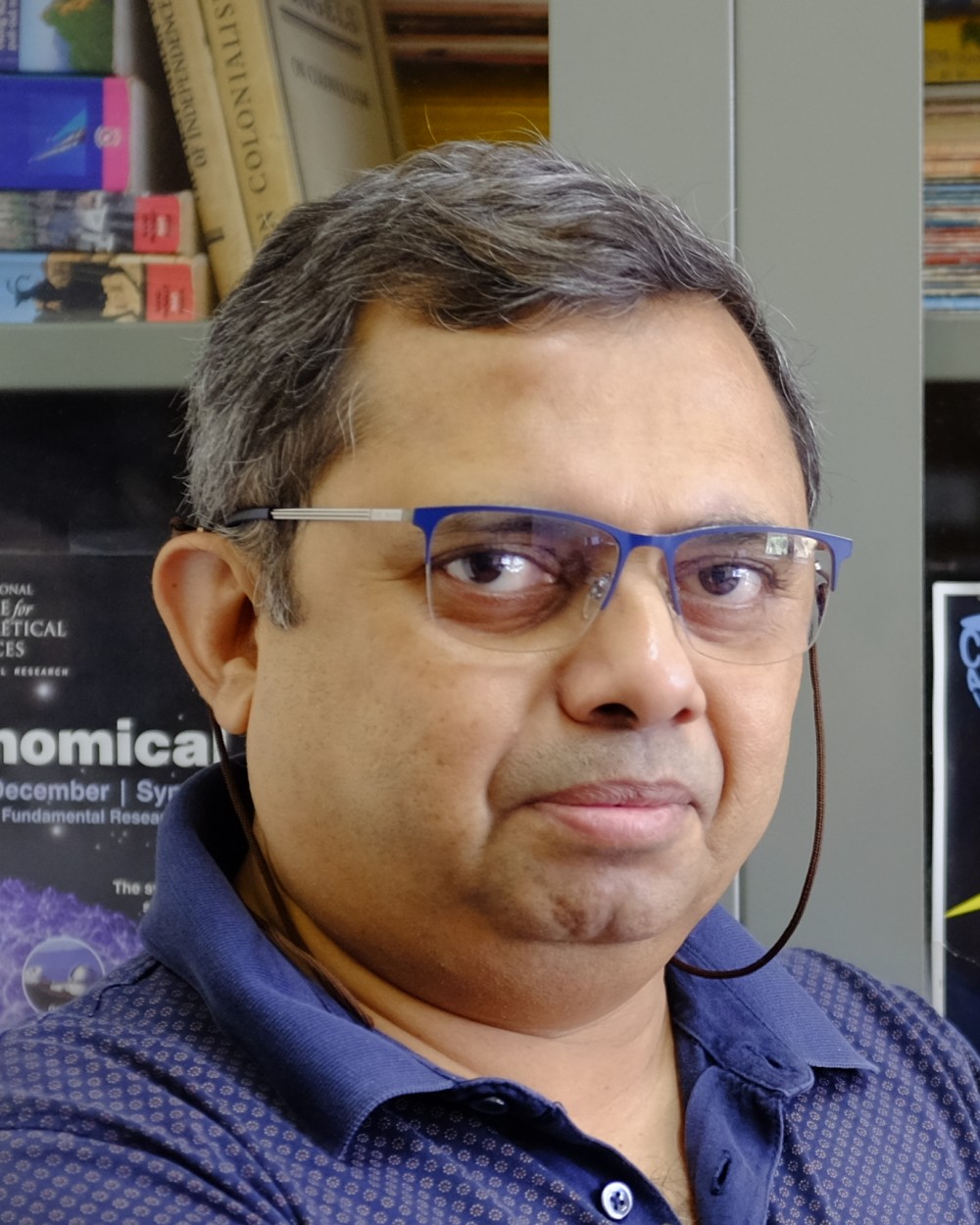
1. G. {Kulkarni}, L. C. {Keating}, M. G. {Haehnelt}, S. E. {Bosman}, E. {Puchwein}, J. {Chardin}, and D. {Aubert}, "Large Ly {\ensuremath{\alpha}} opacity fluctuations and low CMB {\ensuremath{\tau}} in models of late reionization with large islands of neutral hydrogen extending to z < 5.5," \mnras 485 (2019) L24-L28, arXiv:1809.06374 [astro-ph.CO]
2. R. {Hills}, G. {Kulkarni}, P. D. {Meerburg}, and E. {Puchwein}, "Concerns about modelling of the EDGES data," \nat 564 (2018) E32-E34, arXiv:1805.01421 [astro-ph.CO]
3. S. {Mittal}, A. {Ray}, G. {Kulkarni}, and B. {Dasgupta}, "Constraining primordial black holes as dark matter using the global 21-cm signal with X-ray heating and excess radio background," \jcap 2022 (2022) 030, arXiv:2107.02190 [astro-ph.CO]
Profile Picture

Subhabrata Majumdar

Professor (H)

22782203

Room A 309

subha@theory.tifr.res.in

Personal Webpage

Research Interests

Prof. Subha Majumdar’s research spans precision cosmology, secondary CMB anisotropies, large-scale structure and high-energy astrophysics, with a central focus on using cosmic observables to probe the hidden physics of the Universe. A central pillar of his research has been the development of robust theoretical and statistical frameworks that connect astrophysical complexity with cosmological inference. His work on self-calibration techniques for galaxy cluster surveys, cluster abundance and clustering statistics, and the impact of cluster structural evolution has been foundational in establishing galaxy clusters as precision tools for constraining dark energy and the growth of dark matter structure. He is also fascinated with galaxy to cluster `gastrophysics’ —linking intra-cluster thermodynamics, circumgalactic medium, entropy injection by supermassive black holes, and baryonic feedback processes to observables in the microwave and X-ray sky. Prof Majumdar has made important contributions to the secondary CMB distortions; for instance, he was the first to point out how giant radio lobes imprint distinctive non-thermal spectral, and spatial, signatures on the CMB. His review article on secondary CMB anisotropies remains the most comprehensive review of the subject. He is also interested in near-field cosmology, using the Milky Way and nearby galaxies: very recently, he was involved in the construction of a unique and most precise phase-space catalogue of stellar tracers extending from the Milky Way inner regions to the outer halo, providing an unprecedented laboratory for Galactic archaeology, dark matter physics, galactic dynamics, and precision mass modelling, etc.

Prof Majumdar was the first person in the Cosmology and Astroparticle (CAP) group in DTP and has been instrumental in building the group. He was a member of the Department of Astronomy and Astrophysics, TIFR, before moving to DTP, and has held visiting positions in ETH-Zurich (sabbatical) and LMU/MPA, Munich. Before joining TIFR, he was associated with the Astronomy Dept. at UIUC, USA and the Canadian Institute of Theoretical Astrophysics (CITA), Toronto.

Selected Publications
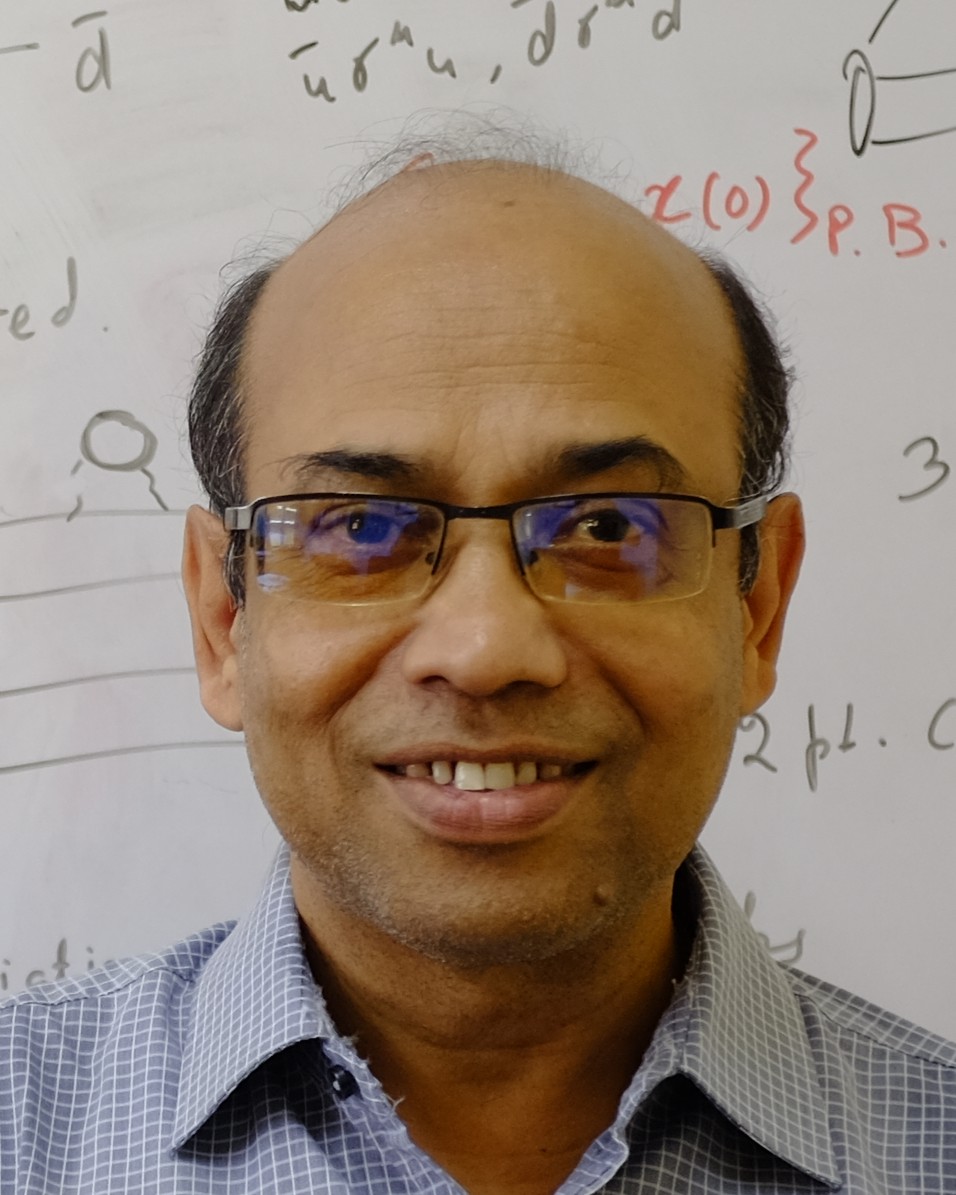
1. S. Majumdar, and J. J. Mohr, "Self calibration in cluster studies of dark energy: Combining the cluster redshift distribution, the power spectrum and mass measurements," Astrophys. J. 613 (2004) 41--50, arXiv:astro-ph/0305341 []
2. N. Aghanim, S. Majumdar, and J. Silk, "Secondary anisotropies of the CMB," Rept. Prog. Phys. 71 (2008) 066902, arXiv:0711.0518 [astro-ph]
3. P. Bhattacharjee, S. Chaudhury, S. Kundu, and S. Majumdar, "Sizing-up the WIMPs of Milky Way : Deriving the velocity distribution of Galactic Dark Matter particles from the rotation curve data," Phys. Rev. D 87 (2013) 083525, arXiv:1210.2328 [astro-ph.GA]
4. D. K. Hazra, S. Majumdar, S. Pal, S. Panda, and A. A. Sen, "Post-Planck Dark Energy Constraints," Phys. Rev. D 91 (2015) 083005, arXiv:1310.6161 [astro-ph.CO]
5. S. Mandal, S. Majumdar, V. Rentala, and R. Basu Thakur, "Observationally inferred dark matter phase-space distribution and direct detection experiments," Phys. Rev. D 100 (2019) 023002, arXiv:1806.06872 [hep-ph]
6. S. K. Acharya, S. Majumdar, and B. B. Nath, "Non-thermal Sunyaev-Zeldovich signal from radio galaxy cocoons," Mon. Not. Roy. Astron. Soc. 503 (2021) 5473--5484, arXiv:2009.03440 [astro-ph.HE]
Profile Picture

Nilmani Mathur

Professor (H)

22782215

Room A 311

nilmani@theory.tifr.res.in

Personal Webpage

Research Interests

1. Lattice Field Theory and its applications to nuclear and particle physics, High-performance computing
2. Quantum computing, AI-ML for physics.

Selected Publications
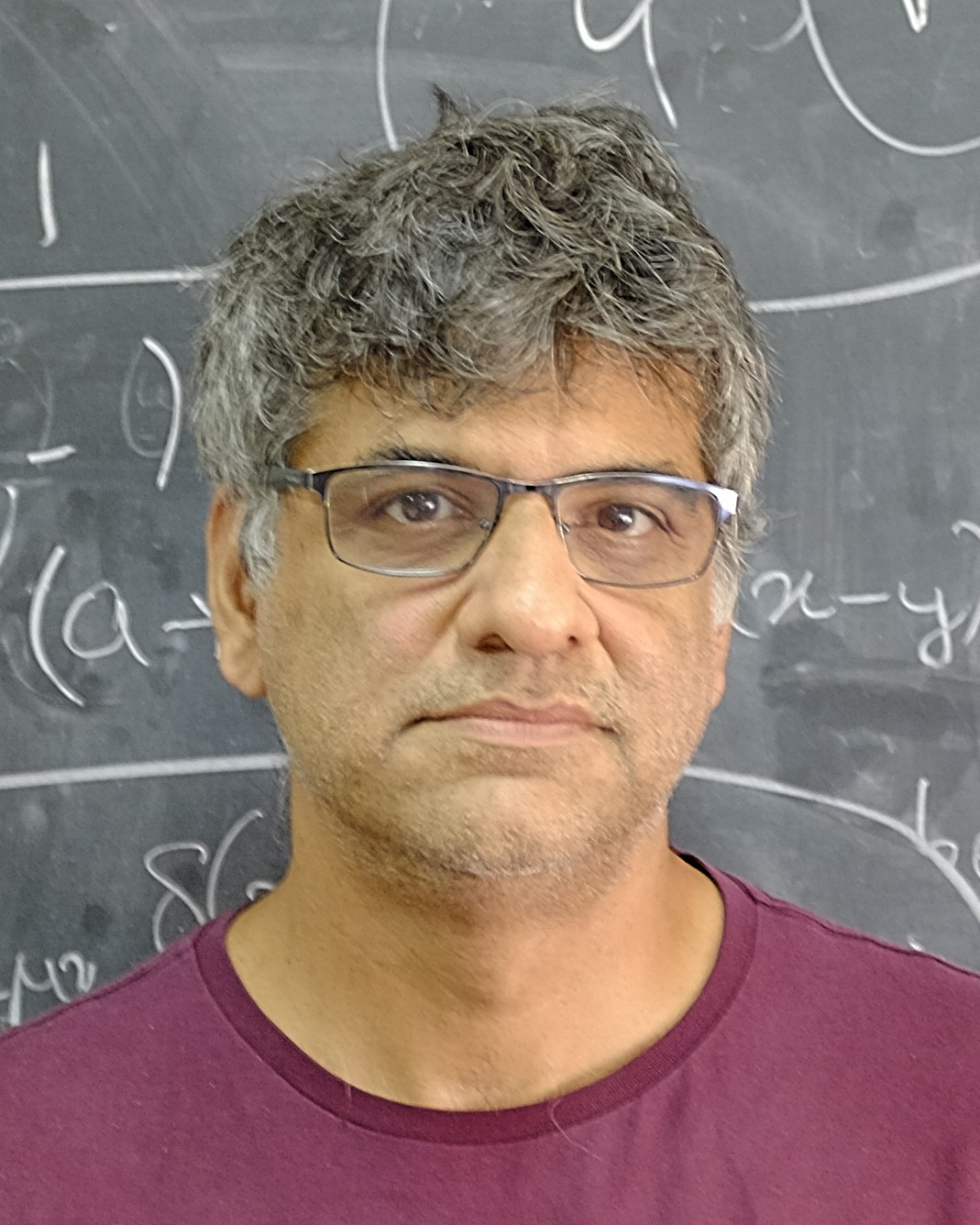
1. D. Chakraborty, P. Srivastava, A. Kumar, and N. Mathur, "Nuclear correlation functions using first-principle calculations of lattice quantum chromodynamics," Phys. Rev. D 110 (2024) 114505.
2. N. Mathur, M. Padmanath, and D. Chakraborty, "Strongly Bound Dibaryon with Maximal Beauty Flavor from Lattice QCD," Phys. Rev. Lett. 130 (2023) 111901.
Profile Picture

Shiraz Minwalla

Distinguished Professor (J)

22782212

Room A 316

minwalla@theory.tifr.res.in

Personal Webpage

Research Interests

Prof. Minwalla studies various aspects of quantum field theory, gravity, and their interrelation via the AdS/CFT correspondence of string theory. His key contributions, to date, include: (1) The study of interplay between bulk black hole and boundary CFT dynamics, including, especially the discovery and detailed study of the fluid gravity correspondence; (2) The classifications of unitary representations of the conformal and superconformal algebra, the discovery of a superconformal index, and (3) The demonstration of (semi) universality of the thermodynamics of conformal field theories in at high energies and spin in larger than two spacetime dimensions; (4) The discovery of new black hole solutions in AdS (grey galaxies and DDBHs) and their use in characterizing the density of states of holographic theories like N=4 Yang Mills; (5) The demonstration that Chern Simons theories with fundamental matter are solvable in the large N limit, and the use of these solutions to uncover several unusual phenomena in these theories, including modified crossing symmetry rule, unusual statistics and Bose Fermi duality; (6) The discovery of new membrane like effective description of black hole dynamics in large numbers of spacetime dimensions; (7) A detailed study of UV IR mixing and solitionic solutions in noncommutative theories, together with the discovery of new noncommutative open string theories, and the characterization of a web of dualities involving these theories; (8) The conjecture that physically consistent gravitational scattering amplitudes with poles but no cuts are so constrained by general physical principles that they can effectively be enumerated.

Prof. Minwalla's work has been recognized by several awards including the New Horizons Breakthrough Award, the Infosys prize, the TWAS prize, the Shanti Swarup Bhatnagar Award, the Nishina Asia Award, the ICTP prize, the IIT Kanpur Distinguished Alumnus Award, , the Sloan Fellowship, J.C. Bose fellowship, and memberships of the Indian Academy of Science, the Indian National Science Academy and The World Academy of Science. As another measure of the impact of his work 38 of Prof. Minwalla's papers have received over 100 citations; five of these papers have been cited on over 500 occasions (according to the Inspire database as of April 13, 2026).

Selected Publications

1. S. Bhattacharyya, V. E. Hubeny, S. Minwalla, and M. Rangamani, "Nonlinear Fluid Dynamics from Gravity," JHEP 02 (2008) 045, arXiv:0712.2456 [hep-th]
2. N. Banerjee, J. Bhattacharya, S. Bhattacharyya, S. Jain, S. Minwalla, and T. Sharma, "Constraints on Fluid Dynamics from Equilibrium Partition Functions," JHEP 09 (2012) 046, arXiv:1203.3544 [hep-th]
3. S. Bhattacharyya, S. Lahiri, R. Loganayagam, and S. Minwalla, "Large rotating AdS black holes from fluid mechanics," JHEP 09 (2008) 054, arXiv:0708.1770 [hep-th]
4. O. Aharony, J. Marsano, S. Minwalla, K. Papadodimas, and M. Van Raamsdonk, "The Hagedorn - deconfinement phase transition in weakly coupled large N gauge theories," Adv. Theor. Math. Phys. 8 (2004) 603--696, arXiv:hep-th/0310285 []
5. S. Minwalla, "Restrictions imposed by superconformal invariance on quantum field theories," Adv. Theor. Math. Phys. 2 (1998) 783--851, arXiv:hep-th/9712074 []
6. J. Kinney, J. M. Maldacena, S. Minwalla, and S. Raju, "An Index for 4 dimensional super conformal theories," Commun. Math. Phys. 275 (2007) 209--254, arXiv:hep-th/0510251 []
7. S. Giombi, S. Minwalla, S. Prakash, S. P. Trivedi, S. R. Wadia, and X. Yin, "Chern-Simons Theory with Vector Fermion Matter," Eur. Phys. J. C 72 (2012) 2112, arXiv:1110.4386 [hep-th]
8. S. D. Chowdhury, A. Gadde, T. Gopalka, I. Halder, L. Janagal, and S. Minwalla, "Classifying and constraining local four photon and four graviton S-matrices," JHEP 02 (2020) 114, arXiv:1910.14392 [hep-th]
9. S. Kim, S. Kundu, E. Lee, J. Lee, S. Minwalla, and C. Patel, "Grey Galaxies{\textquoteright} as an endpoint of the Kerr-AdS superradiant instability," JHEP 11 (2023) 024, arXiv:2305.08922 [hep-th]
10. H. Anand, N. Benjamin, V. Kumar, S. Minwalla, J. Mukherjee, S. Pal, and A. Rahaman, "Semi-universality of CFT$_d$ entropy at large spin," (2025) , arXiv:2512.00158 [hep-th]
Profile Picture

Onkar Parrikar

Reader

22782211

Room A439

parrikar@theory.tifr.res.in

Research Interests

Quantum gravity, quantum information theory, quantum field theory, AdS/CFT

Selected Publications
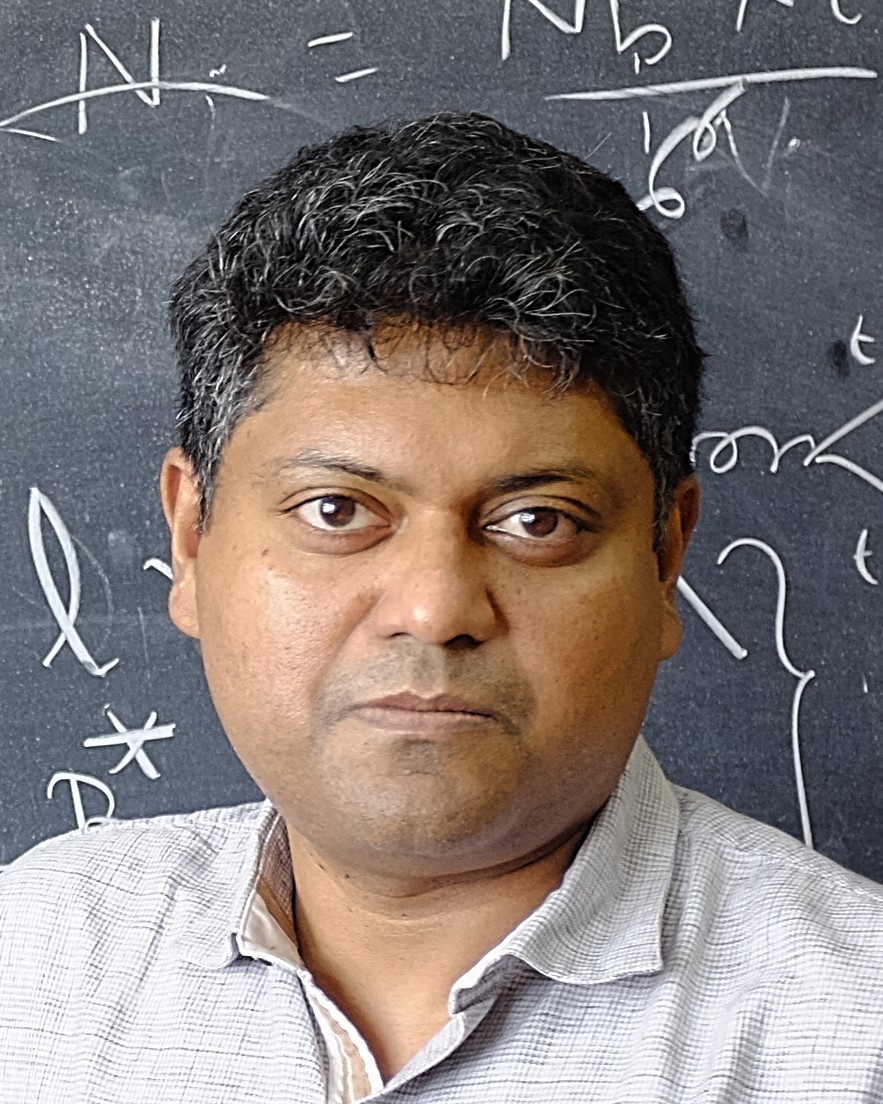
1. T. Faulkner, R. G. Leigh, O. Parrikar, and H. Wang, "Modular Hamiltonians for Deformed Half-Spaces and the Averaged Null Energy Condition," JHEP 09 (2016) 038, arXiv:1605.08072 [hep-th]
2. T. Faulkner, F. M. Haehl, E. Hijano, O. Parrikar, C. Rabideau, and M. Van Raamsdonk, "Nonlinear Gravity from Entanglement in Conformal Field Theories," JHEP 08 (2017) 057, arXiv:1705.03026 [hep-th]
3. R. Basu, O. Parrikar, S. Paul, and H. Rajgadia, "On the stabilizer complexity of Hawking radiation," (2025) , arXiv:2510.18967 [hep-th]
Profile Picture

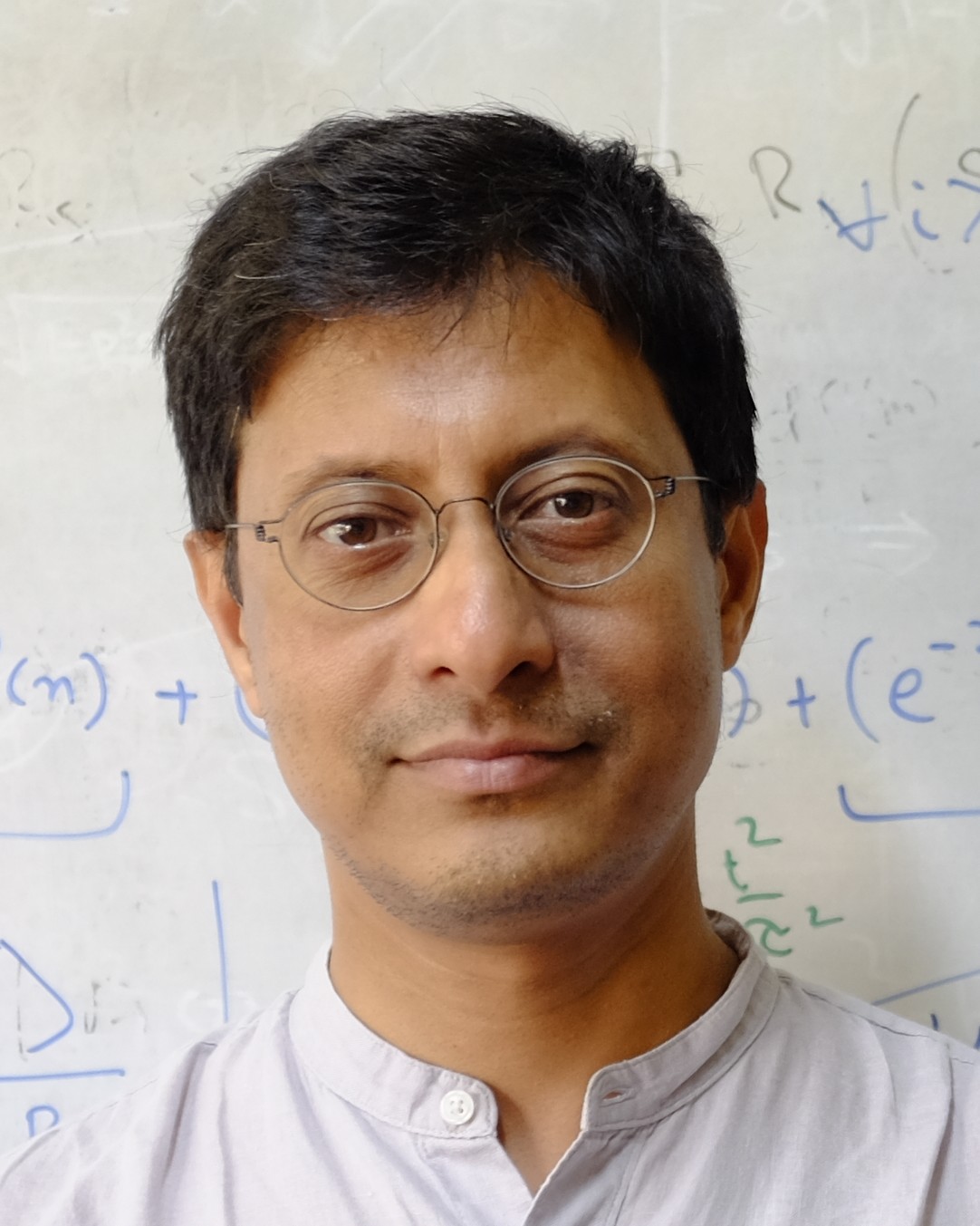
Tuhin S. Roy

Associate Professor (G)

22782277

Room A429

tuhin@theory.tifr.res.in

Personal Webpage

Research Interests

Prof. Roy is a particle physicist: an effective field theorist and a phenomenologist. His research encompasses topics ranging from building models of short-distance particle physics, collider physics, physics of jets and jet-substructure physics, flavor physics, cosmology and astro-particle physics, analytical approaches to field theories in the strong coupling limit, and visiting places where effective field theory approaches take him.

Along with colleagues from high energy physics and nuclear physics, Prof. Roy has recently initiated a project "Indian Mission in Positronium Experimental Thrust for Ultra-precision Searches" or IMPETUS, with the vision to build an End2End Indian experiment.

Selected Publications
1. C. Csaki, T. S. Roy, M. Ruhdorfer, and T. Youn, "Dynamical Up-quark Mass Generation in QCD-like theories," (2025) , arXiv:2505.07953 [hep-ph]
2. S. D. Ellis, A. Hornig, T. S. Roy, D. Krohn, and M. D. Schwartz, "Qjets: A Non-Deterministic Approach to Tree-Based Jet Substructure," Phys. Rev. Lett. 108 (2012) 182003, arXiv:1201.1914 [hep-ph]
3. G. D. Kribs, T. S. Roy, J. Terning, and K. M. Zurek, "Quirky Composite Dark Matter," Phys. Rev. D 81 (2010) 095001, arXiv:0909.2034 [hep-ph]
4. A. G. Cohen, T. S. Roy, and M. Schmaltz, "Hidden sector renormalization of MSSM scalar masses," JHEP 02 (2007) 027, arXiv:hep-ph/0612100
Profile Picture

Tridib Sadhu

Associate Professor (G)

22782216

Room A322

tridib@theory.tifr.res.in

Personal Webpage

Research Interests

Out-of-equilibrium statistical physics, stochastic processes, and mathematical physics, aiming to develop a general framework for non-equilibrium statistical mechanics.

Selected Publications

1. B. Derrida, and T. Sadhu, "Large deviations conditioned on large deviations {I}: {M}arkov chain and {L}angevin equation," Journal of Statistical Physics 176 (2019) 773--805.
2. P. L. Krapivsky, K. Mallick, and T. Sadhu, "Large Deviations in Single-File Diffusion," Physical Review Letters 113 (2014) 078101.
3. T. Sadhu, and K. W. Jorg, "Functionals of fractional Brownian motion and the three arcsine laws," Physical Review E 104 (2021) 054112.
Profile Picture

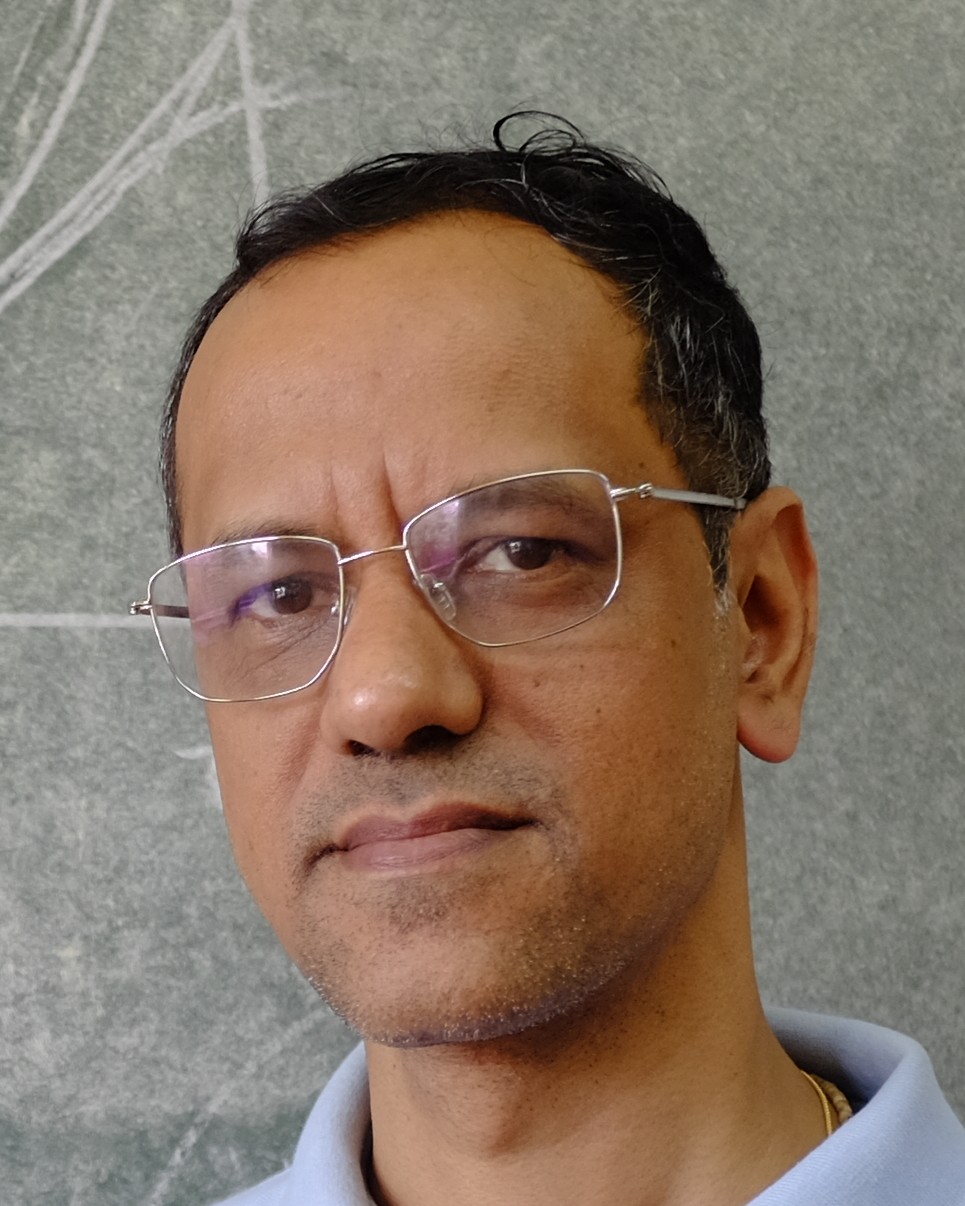
Rajdeep Sensarma

Professor (H)

22782431

Room A 325

sensarma@theory.tifr.res.in

Personal Webpage

Research Interests

Quantum Information in Many Body System
Non Equilibrium Dynamics of Quantum Systems
Strongly Fluctuating Superconductors
Van der Waals Materials

Selected Publications
1. S. Biswas, S. Suman, M. Randeria, and R. Sensarma, "Andreev versus tunneling spectroscopy of unconventional flat-band superconductors," Proceedings of the National Academy of Sciences 122 (2025) e2509881122.
2. S. Moitra, and R. Sensarma, "Building entanglement entropy out of correlation functions for interacting fermions," Phys. Rev. B 108 (2023) 174309.
3. A. Chakraborty, and R. Sensarma, "Nonequilibrium Dynamics of Renyi Entropy for Bosonic Many-Particle Systems," Phys. Rev. Lett. 127 (2021) 200603.
Profile Picture

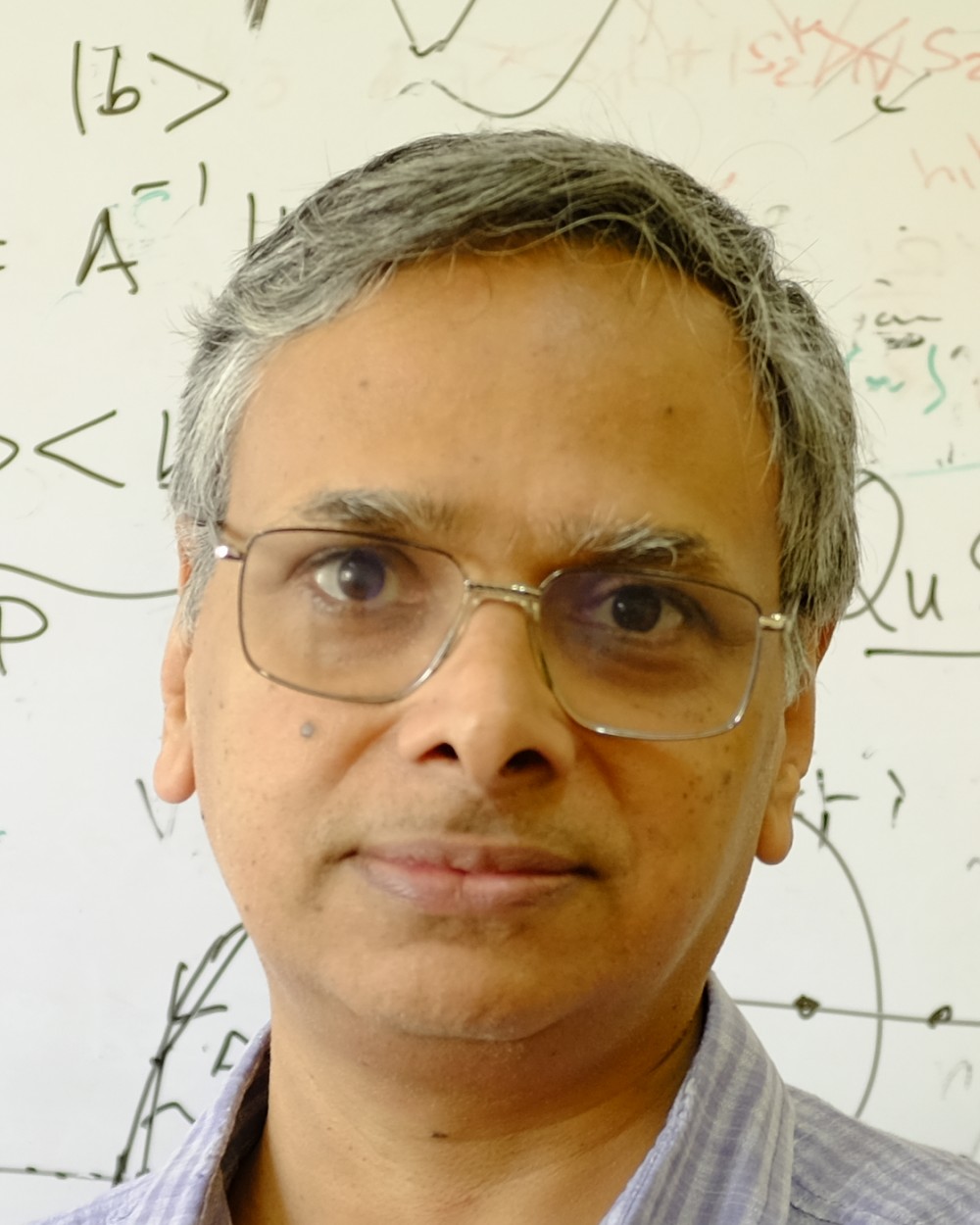
Rishi Sharma

Associate Professor (G)

22782140

Room A 432

rishi@theory.tifr.res.in

Research Interests

Rishi Sharma is interested in the properties of phases of QCD at finite temperatures and finite chemical potentials. These phases can be observed in heavy ion collisions, and affect the structure and dynamics of compact stars.

Effective Field Theory (EFT) techniques are particularly useful for understanding the dynamical properties of these phases, by allowing one to factorise observables into quantities that can be computed within the EFT in a controlled manner, and parts that can be matched to correlation functions which may be computed non-perturbatively using lattice QCD.

Selected Publications
1. S. Gupta, and R. Sharma, "Effective field theory for warm QCD," Phys. Rev. D 97 (2018) 036025, arXiv:1710.05345 [hep-ph]
2. R. Sharma, and A. Tiwari, "Quantum evolution of quarkonia with correlated and uncorrelated noise," Phys. Rev. D 101 (2020) 074004, arXiv:1912.07036 [hep-ph]
3. M. S. Ali, C. A. Islam, and R. Sharma, "Studying explicit U(1)A symmetry breaking in a hot and magnetized two flavor nonlocal NJL model constrained using lattice results," Phys. Rev. D 104 (2021) 114026, arXiv:2009.13563 [hep-ph]
Profile Picture

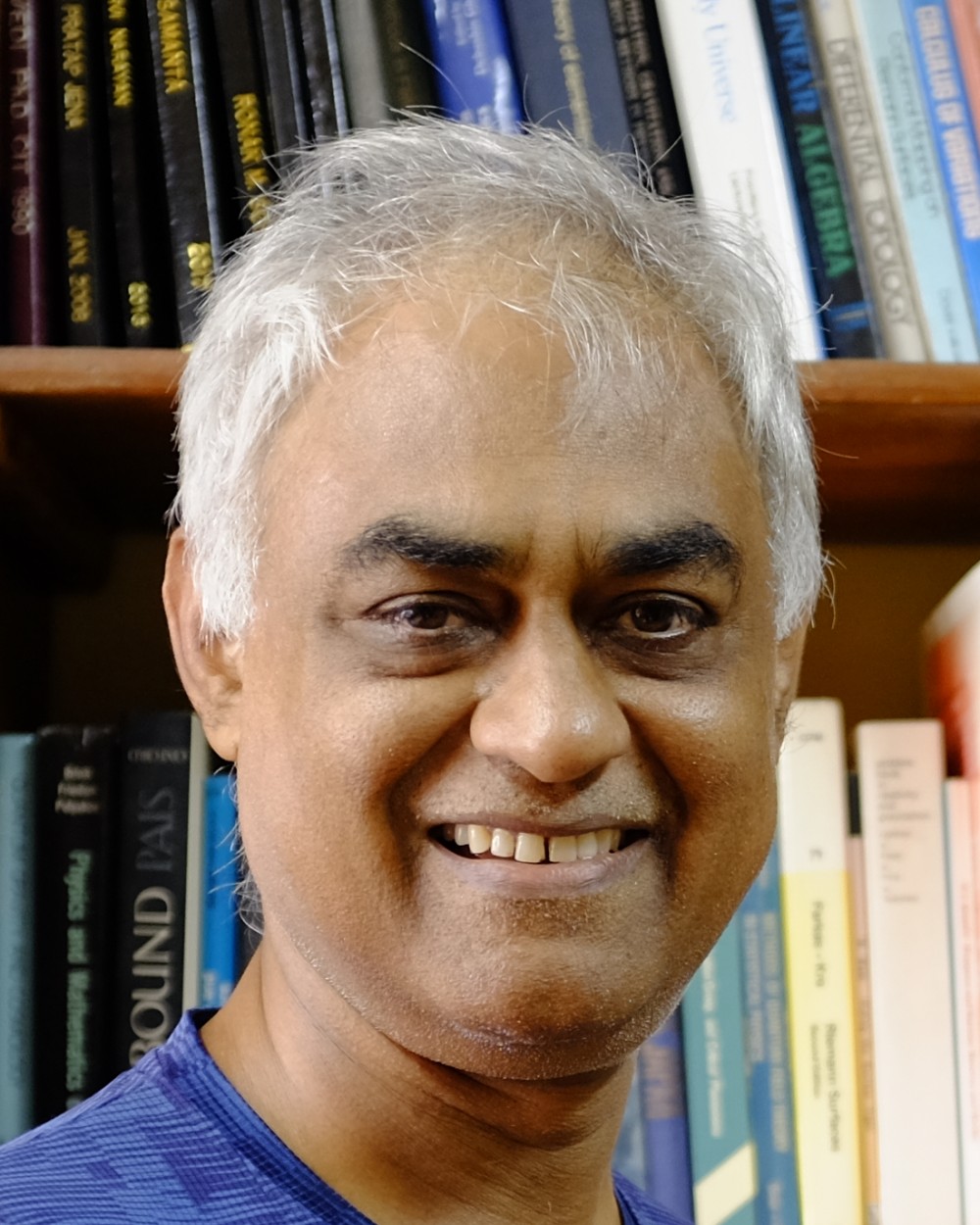
Vikram Tripathi

Professor (H)

22782720

Room A 312

vtripathi@theory.tifr.res.in

Research Interests

1. Topological order in quantum spin systems: characterization, gauge theories, lattice effects, quasiparticle stability, finite-temperature thermal Hall transport.
2. Quantum scars: classification, detection, hidden symmetry-protected trivial (SPt) character
3. Non-invertible dualities in 2D systems with subsystem symmetries
4. Quantum algorithms for linear solving
5. Autonomous swarming strategies using sparse information

Selected Publications
1. A. Maity, V. Tripathi, and A. H. Nevidomskyy, "Web of Non-invertible Dualities for (2+ 1) Dimensional Models with Subsystem Symmetries," arXiv preprint arXiv:2511.18969 (2025) , arXiv:2511.18969
2. A. Maity, H. Guo, S. Sachdev, and V. Tripathi, "Thermal Hall response of an Abelian chiral spin liquid at finite temperatures," Phys. Rev. B 111 (2025) 205119.
3. S. Kumar, S. Sharma, and V. Tripathi, "Counterdiabatic route for preparation of state with long-range topological order," Phys. Rev. B 104 (2021) 245113.
4. A. Kumar, and V. Tripathi, "Kitaev quasiparticles in a proximate spin liquid: A many-body localization perspective," Phys. Rev. B 102 (2020) 100401.
6. S. D. Das, S. Kundu, Z. Zhu, E. Mun, R. D. McDonald, G. Li, L. Balicas, A. McCollam, G. Cao, J. G. Rau, H. Kee, V. Tripathi, and S. E. Sebastian, "Magnetic anisotropy of the alkali iridate ${\mathrm{Na}}_{2}{\mathrm{IrO}}_{3}$ at high magnetic fields: Evidence for strong ferromagnetic Kitaev correlations," Phys. Rev. B 99 (2019) 081101.
7. V. Tripathi, A. Galda, H. Barman, and V. M. Vinokur, "Parity-time symmetry-breaking mechanism of dynamic Mott transitions in dissipative systems," Phys. Rev. B 94 (2016) 041104.
8. M. Mondal, A. Kamlapure, M. Chand, G. Saraswat, S. Kumar, J. Jesudasan, L. Benfatto, V. Tripathi, and P. Raychaudhuri, "Phase Fluctuations in a Strongly Disordered $s$-Wave NbN Superconductor Close to the Metal-Insulator Transition," Phys. Rev. Lett. 106 (2011) 047001,
9. K. Dhochak, R. Shankar, and V. Tripathi, "Magnetic Impurities in the Honeycomb Kitaev Model," Phys. Rev. Lett. 105 (2010) 117201,
10. P. Chandra, P. Coleman, J. Mydosh, and V. Tripathi, "Hidden orbital order in the heavy fermion metal URu$_2$Si$_2$," Nature 417 (2002) 831--834,
Profile Picture

Sandip P. Trivedi

Distinguished Professor (J)

22782424

Room A319

sandip@theory.tifr.res.in

Personal Webpage

Research Interests

String theory and mathematical physics.

Selected Publications

1. I. Dey, K. K. Nanda, A. Roy, D. K. Sharma, and S. P. Trivedi, "The Thermodynamics of Cosmological Horizons and Their Holographic Description in de Sitter Space," (2026) , arXiv:2604.25035 [hep-th]
2. O. Parrikar, J. Narde, H. Rajgadia, and S. Trivedi, "Entanglement spreading and emergent locality in Brownian SYK chains," (2025) , arXiv:2508.00060 [hep-th]
3. I. Dey, K. K. Nanda, A. Roy, S. K. Sake, and S. P. Trivedi, "JT gravity in de Sitter space and its extensions," JHEP 03 (2026) 196, arXiv:2501.03148 [hep-th]